


01 · The Patient
An 89-year-old man with severe systemic frailty returned to our attention with a recurrent arterial ulcer on the lateral side of the foot.
His medical history was highly complex. He suffered from untreated diabetes, hypertension, hyperuricemia, JAK2-positive polycythemia vera treated with oncocarbide, nephroangiosclerosis and stage IIIa chronic kidney disease, previously complicated by an acute episode of hyperkalemia. He also had benign prostatic hypertrophy treated with transurethral resection and a history of multiple emergency department visits for hypertensive crises.
The patient had already been managed at our facility for severe non-revascularizable peripheral arterial disease. In that earlier episode, amputation had been proposed but refused by the patient and his relatives. A previous course of mononuclear cell treatments had allowed clinical resolution and discharge.
When he returned in September 2025, the clinical picture was therefore not a first episode, but a recurrence in an already compromised vascular and fibrotic wound bed.
02 · The Wound
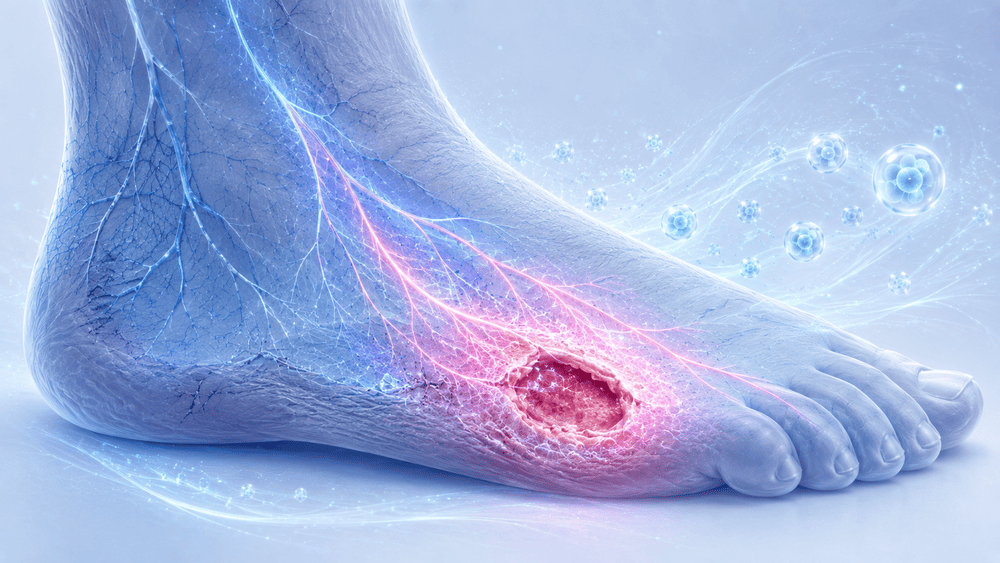
The recurrence was located on the lateral side of the foot and had appeared approximately two months before follow-up.
At presentation, the lesion was associated with severe pain, with an NRS score of 8. The wound developed in a tissue area already marked by severe ischemia and scarring fibrosis from the previous deep lesion.
Oximetry confirmed the severity of the local vascular impairment, with oxygen saturation values of 14% in the supine position and 16% in the semi-recumbent position.
An arterial Doppler ultrasound showed a stable but severely compromised vascular picture, with multiple occlusions and peripheral circulation supported by recanalized anterior tibial arteries.
03 · Prior treatment history
Before this recurrence, the patient had already experienced a severe ulcerative episode related to non-revascularizable peripheral arterial disease.
During that first episode, amputation had been suggested as a possible outcome, but the patient and his family refused. After debridement of the wound bed, a course of mononuclear cell treatments had been performed, leading to resolution and discharge.
The recurrence appeared several months later, in a context where the wound bed had already undergone major biological stress. The previous deep injury had inevitably left fibrosis, which represented an additional obstacle to tissue repair.
The patient’s physician had attempted topical therapy for the new recurrence, but without success. Given the vascular background, the persistence of pain and the fibrotic wound bed, standard local management alone was considered insufficient.
04 · Decision and protocol
Because of the combination of recurrent ulceration, severe non-revascularizable PAD, localized hypoxia and wound-bed fibrosis, a combined treatment with E-PRP and CGF was indicated.
The rationale was to provide a regenerative stimulus capable of supporting local vascular compensation, reducing inflammation and improving the biological quality of the wound bed.
E-PRP was selected for its injectable action in and around the lesion, typically along the relevant vascular axis. CGF was used as a dense platelet-fibrin matrix, shaped as a membrane and applied to cover the lesion.
The treatment was performed using the High Q Cell® All-In-One procedural kit, allowing both blood components to be obtained from autologous blood during the same procedure.
05 · Clinical response
On October 13, 2025, physical examination showed that the recurrence covered an area of 3.55 cm² and was very painful, with an NRS score of 8.
On the same day, the patient underwent the first E-PRP and CGF grafting procedure using the High Q Cell® All-In-One kit. No postoperative complications were reported.
At follow-up on November 27, 2025, the wound had already reduced to 2.10 cm². Pain had also decreased, with the NRS score dropping from 8 to 5.
The wound showed a marked improvement in vascularization, although persistent desquamation along the wound margin suggested that local inflammation was still active. This was consistent with the patient’s comorbidities and systemic pro-inflammatory background.
Analgesic therapy was reduced, and the second E-PRP and CGF graft was administered as planned, again using the same procedural approach.
06 · Outcome and follow-up
On December 19, 2025, the clinical presentation of the lesion had resolved.
The patient was discharged with analgesic therapy discontinued and cilostazol continued. The absence of pain represented a particularly relevant outcome in this elderly and fragile patient, as pain control had been one of the main clinical problems at recurrence.
At discharge, oximetric assessment showed a marked improvement, with TcPO₂ values of 41% in the upright position and 50% in the supine position.
The case therefore achieved complete clinical resolution within approximately two months from the first E-PRP and CGF application, with no reported postoperative complications.
07 · Discussion
This case highlights the potential value of regenerative medicine in recurrent vascular ulceration when standard options are limited or unavailable.
The patient was extremely frail, with severe non-revascularizable peripheral arterial disease, diabetes, chronic renal failure, thrombocytosis and a fibrotic wound bed resulting from a previous deep injury. In such a context, recurrence is common and treatment options are often very limited.
The response suggests that E-PRP and CGF may have acted on multiple biological levels. First, the treatment appeared to compensate for underlying localized hypoxia, as shown by the improved oximetric values at discharge. Second, it may have contributed to modulation of the pro-inflammatory state, particularly through mononuclear-cell activity and the macrophage M1-to-M2 switch. Third, the local regenerative stimulus may have improved the quality of scarred and fibrotic tissue.
The most clinically meaningful outcomes were complete lesion resolution, significant pain reduction, discontinuation of analgesic therapy and improved oxygenation.
This case also confirms the importance of early intervention in recurrence. In vascular patients, relapse is frequent, but when treated early and in a structured way, regenerative approaches may provide an effective therapeutic option even in patients with no remaining revascularization possibilities.