


01 · The Patient
A 59-year-old male was referred to our vulnology service with a long and complex history of recurrent ulceration in a post-surgical area of the left lower limb. At the age of eighteen, the patient had suffered a severe traumatic injury resulting in vascular damage, fasciitis, forefoot amputation, arthrodesis, and reconstruction with a pedicled flap.
Since that reconstructive procedure, the flap area had remained clinically fragile. Over the following decades, the patient experienced repeated ulcer recurrences at the same site, with increasingly short symptom-free intervals. By the time of referral, the condition had become a persistent clinical burden, associated with chronic pain and a significant reduction in quality of life.
His medical history included hypertension and hypercholesterolemia. He also reported allergies to silver sulfadiazine and sulfamethoxazole-trimethoprim. Pharmacological therapy included ramipril, amlodipine and simvastatin, with NSAIDs used to control ulcer-related pain.
02 · The Wound
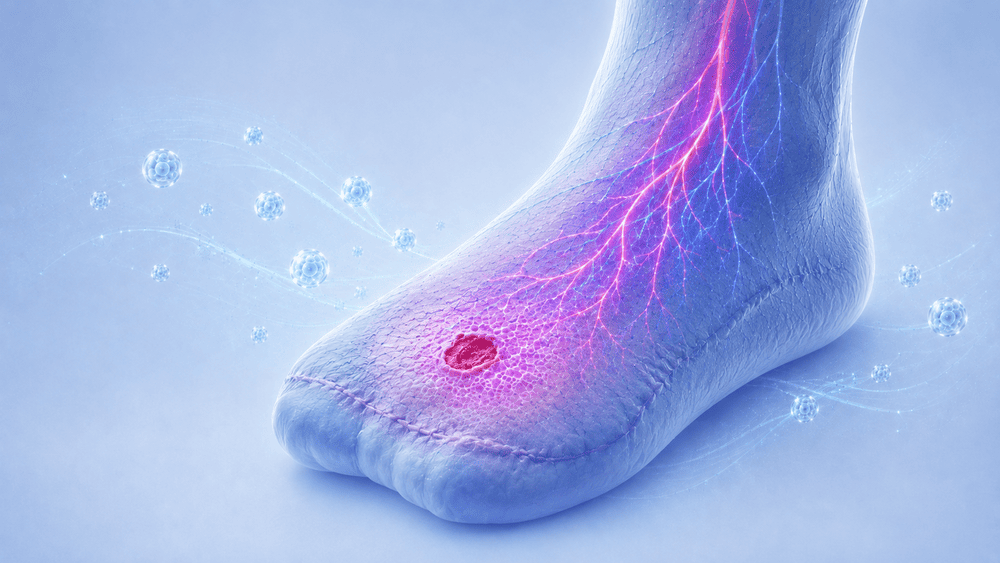
The lesion was located in the reconstructed forefoot area, corresponding to the pedicled flap created after the original trauma. This area had progressively developed the characteristics of a chronic, poorly vascularized wound bed.
At presentation on 23 November 2022, the lesion measured 1.62 cm² and was moderately painful, with an NRS pain score of 5. The most relevant finding, however, was not only the wound area, but the biological context in which the ulcer had developed: an oximetric assessment revealed extremely poor flap oxygenation, with a TcPO₂ value of 8, while the surrounding tissue showed normal values between 40 and 60.
This confirmed the presence of a post-surgical avascular area, explaining the persistence and recurrence of the ulcer over time.
03 · Prior treatment history
Before PBMNC therapy was considered, the patient had already undergone multiple conservative and advanced treatments. Two grafting procedures using bioengineered materials had been performed, but both failed to take.
Physical therapies were also attempted, including photobiomodulation and electrostimulation, without appreciable clinical improvement. One year later, on 7 November 2023, the wound remained unresolved; indeed, the lesion area had increased, stabilizing at approximately 2.54 cm² after reaching almost 6 cm², while pain remained uncontrolled at NRS 5.
The clinical picture therefore confirmed a chronic, recurrent and treatment-resistant ulcer in an avascular post-surgical flap.
04 · Decision and protocol
Given the failure of previous treatments and the extremely low oxygenation of the flap, the decision was made to proceed with mononuclear cell therapy using High Q Cell® Liquid+.
The objective was to reactivate angiogenic processes in the avascular area and provide a targeted regenerative stimulus to the entire flap bed. The standard E-PRP protocol was adapted to the specific clinical condition: instead of treating only the wound margins and surrounding area, the treatment focused on the whole flap bed, including the ulcer and the 10 cm segment proximal to the flap.
A three-application cycle was selected, rather than the standard two-application approach, in order to maintain biological stimulation over time and support the expected angiogenic response in a particularly compromised tissue environment.
05 · Clinical response
The first PBMNC graft was performed on 23 November 2023 using the High Q Cell® Liquid+ procedural kit. No adverse events were reported.
A second PBMNC graft was performed on 12 January 2024, again without complications. At follow-up on 23 January 2024, the lesion area had already decreased to 0.92 cm². More importantly, pain was drastically reduced from NRS 5 to NRS 1, to the point that NSAID administration for wound-related pain could be discontinued.
Encouraged by the first clear signs of clinical response, a third and final PBMNC graft was performed on 15 March 2024, again without adverse events.
One month after the end of the E-PRP cycle, on 17 April 2024, the wound area measured 1.25 cm², but pain had completely disappeared, with an NRS score of 0.
06 · Outcome and follow-up
By 10 September 2024, six months after the end of the treatment cycle, the lesion had significantly reduced to 0.36 cm², with no pain.
On 1 October 2024, the lesion was documented as fully resolved. More importantly, at follow-up on 12 January 2026 — more than one year after treatment — the wound remained closed and recurrence-free, a result the patient had not experienced for over twenty years.
A new oxygenation assessment of the flap showed a TcPO₂ value of 37. Although not perfect, this value was within normal limits and represented a 365% increase compared to the initial assessment.
No adverse events were recorded during the treatment course.
07 · Discussion
This case illustrates the potential role of E-PRP in a highly selected, complex chronic wound: a recurrent ulcer in a post-surgical avascular flap that had remained clinically unstable for decades.
The case was extreme not only because of the duration of the problem, but because the underlying issue was not a simple open wound. The lesion developed in a reconstructed area with poor vascular supply, chronic inflammatory activity and repeated failure of previous treatments.
The response observed after PBMNC therapy suggests a combined mechanism: angiogenic stimulation with improved local perfusion, modulation of chronic inflammation through macrophage transition from M1 to M2, and an improvement in local tissue conditions that allowed the wound to finally progress toward closure.
The most clinically relevant outcome was not only wound closure, but the absence of recurrence for more than one year after treatment — a stability that had not been achieved for over two decades. In this context, the increase in local oxygenation and the complete disappearance of pain represent key indicators of a meaningful biological change in the treated flap.
This treatment did not replace correct wound assessment or standard care principles. Rather, it offered a targeted regenerative option in a wound bed that had stopped responding to conventional approaches.